March 19, 2009

2JB Interlude: Scotland

Nahum and I are enjoying a short (and rare) break between batches, but that doesn't mean there is no beer news to report. Last week, I took a 5-day trip to Scotland with my friend Lee. He was going on an art-related trip and invited me along...which I took as a sign to make it a beer-related trip, too.

A quick bit of back-story: I've lived in Scotland for periods here & there, and I visit when I can. In fact, my time in the UK is where my "beer palate" did most of its maturing. I was very excited to return, not least of all to have some of my fave Brit Brews and try some new ones. I documented all of my Scotland beers, and present a wee travel diary:

3/11/09: Arrived in Edinburgh for the first time in about 5 years. After a quick nap, I headed to one of my old haunts, the Royal Ettrick Hotel, for a proper pub lunch. (How I missed you, pub lunches!). I quenched my jet-lagged thirst with a pint of Tennant's lager, brewed in Glasgow.


It's a cold, clear lager with carbonation roughly akin to champagne. It made me happy all the way down to my toes, and paired with the lasagna perfectly. Actually, I have no idea if it went with the food...the whole experience was just heavenly, though.

Later that evening, Lee arrived and it was right back to the Ettrick for another round of Tennant's. I wouldn't want to keep it all to myself, right?


3/12/09: After a long day of travel through the Highlands, Lee and I arrive in Ft. William (up the west coast of Scotland). Ft. William is at the foot of the tallest peak in the UK, Ben Nevis...so it's no surprise that the Ben Nevis pub offers one of the nicest views in town. I started with a McEwan's 70, which is a smooth, creamy ale with a medium color and light carbonation.


McEwan's is a longtime Edinburgh brewery that was later bought by Caledonian...but I believe it is still made right in Scotland. Speaking of Caledonian...Lee had the Caledonian 80 and spoke so highly of it that I joined in for a second round. The Callie was even creamier than the McE, and a bit darker. (Neither was particularly hoppy...these Scottish brewers seem to be more into the malts, which I guess shouldn't be too surprising).


Oh, and dinner was a steak & ale pie. What goes with steak & ale pie? Some McEwan's ale, that's what!


3/13/09: We spent the day doing quite a bit of trekking, and even had a near-miss with some aggressive Highland bulls.


After some nice locals in a way out-of-the-way town gave us a lift to a slightly bigger town, we waited for the train at the Marine Hotel's bar. The pickings were slim, so we went for half-pints of Guinness.


I should note that there is a promotion of sorts with Guinness that was new to me: Guinness Extra Cold. It's a separate tap, with its own logo and everything. It's just like Guinness...but colder. Still delicious, though.

For dinner, we headed to the Grog & Gruel, which aside from a bizarre Tex-Mex menu (In the Highlands? Really?) boasted of a large selection of Scottish cask-conditioned ales! How was I going to pass that up? Well, I didn't.

It was a bit of a tease, though. The menu listed about 25 beers from 5 local brewers, each with descriptions that made the mouth water. I'd picked out the Orkney Dark Island beer from the Sinclair Brewery...when the waitress informed us that the list was just a representation of all the beers they might have. The board behind the bar showed that, in fact, there were 4 to choose from.


I was a bit disappointed, but that all went away when I sipped the pint of Black Cullin from the Isle of Skye Brewing Co. The ingredients included chocolate, oats and other stouty markers, but the beer was decidedly not stout-like. More like the darkest ale you've ever had, with a light body and a ton of flavor. Lee went with the Callie 80 he'd liked so much the night before, but learned the hard way that the hand-pump tap they had at Ben Nevis made a big difference in how the pint went down. Still, better than a can of Coors, right?


For round 2, we ordered the other beers: Young Pretender, also from Isle of Skye, and William's Joker from the Williams Brothers Brewing Company in Alloa.


The Pretender was a very light ale with a crisp flavor and barely any body (but still quite good). The Joker, on the other hand, was heavy, malty and very strong: a bit over 5% alcohol. The overall effect was actually too much for me, and Lee and I had to share responsibility for dealing with the Joker.

At the end of the night, we each had a Tetley ale while bowling 2 games in a black-lit alley. No, I'm not making any of that up. It was the only decent beer they had at the bowling alley, and it went down easy, like a cuppa tea!


3/14: We traveled south again, toward the city. On the train I was busying myself with a crossword puzzle...and wouldn't you know that that answer to 62 across was "beer."


It was our last night in Scotland, back in Edinburgh and staying with our friend Chris. We bought him a 4-pack of McEwan's Export, but ended up going through a couple of bottles of wine before getting some sleep ahead of an early-morning flight.


It was a bit odd to end the trip with wine rather than beer, but I certainly can't complain that I didn't get a sufficient number of Scottish pints. It was great to drink them again, especially now that my 2JB experience allowed me to deliniate some of what was going on in each beer I tried. Nahum and I are in a pretty good spot when it comes to US brews, but we've still got a long way to go to top the centuries of malt & hops goodness to be found in the Scottish cities & Highlands.

March 9, 2009

Porch Sippin'

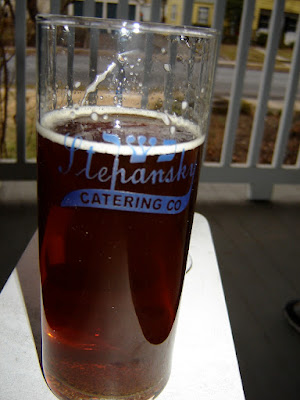
We had just lost an hour to Daylight Savings, but true to its name there seemed to be lots of spring-like daylight on offer this weekend. Since the 2JB Originale had spent just about a week finishing up in the bottles, we'd already planned to sample the brew...and then Nahum asked if I might be interested in sitting out on the front porch to have some beer.

Would I? In the words of the country's most famous Alaskan: You betcha!

I walked across the street, and Nahum was already out with two bottles and a bag of chips.


We popped the tops, settled back into the wooden chairs, raised a hearty "L'chaim" and tipped 'em back.


The verdict, all at once, was that our first shot at an original recipe was right on the money. Floral & a bit citrusy, with lots of layered hops flavors, just a touch of sweetness and a long, smooth aftertaste. Balanced flavor, nice color, just enough of an aroma to tease the taste. Really just a pleasure to drink. And as the just-saved late-day daylight kept the afternoon going, we mused that this was a beer we both really, really liked. And other people would, too. Heck, they might even buy it. From us.


Don't tell the wives, but we spent a solid 15 minutes thinking aloud about how 2JB could be the real thing. That we could go from being guys who made beer to being beer makers. Of course, there are a ton of obstacles (not the least of which being that neither of us is eager to toss aside the jobs we like for something like this...at least not right now) and it's not something we're seriously considering for the immediate future.


But the future is long. It could still happen. To keep things moving in the right direction, we've decided to make another batch or two of the same Originale recipe and see if we have the ability to stay consistent batch to batch (we've yet to make the same thing twice, so we honestly have no idea). And we'll keep our 2JB pipe dreams humming quietly in the background...but mostly just keep on enjoying the brewing and the brews and look forward to more days where we can just sit out on the porch tipping back our very own beer.

March 2, 2009

School's Out for Homebrew

And so it came to pass that the Two Jews beheld their first-ever original-recipe ale. The aroma was most pleasing, the color was bold, and the taste...well, it seems like the Originale is gonna be pretty damn good.

But I'm getting ahead of myself.

We arranged to bottle Batch Vav once again during Nahum's kid's time at Hebrew school. I take no small pleasure that this has come to be the (more or less) regular time for 2JB activity. When I was a kid, one of the things I didn't like about Hebrew school was an unconfirmable but certain feeling that these weekend hours I spent in Hebrew school were being used by other people for seriously fun stuff. And a mere quarter-century later, I have my proof. We're using this little slice of weekend time for serious, big-smile fun...and all because a kid is in Hebrew school and we're not.

But I digress.


Nahum and I got into our now-familiar bottling rhythm: he'd soaked the bottles in a large pot, so I took to sanitizing them while he prepped & sanitized the bottling equipment. He boiled the priming sugar (additional Originale experiment: 4 oz. of brown sugar dissolved into boiling water instead of the corn-starch sugar we've been using) while I sanitized and laid out the bottle caps. After a quick SG reading (1.014), we racked to the bottling bucket, and Nahum filled as I capped. This might be our single smoothest process thus far - efficient, nearly wordless and still producing the deep pleasure of seeing the bottles pile up in the box. Plus, we usually sample the pre-carbonated brew while we do it.


And as I said, the sampling made us very, very happy. As we'd hoped, the beer is floral and a little citrusy; to our surprise, it also has a subtle but sharp sweetness, making it feel crisp even though it's yet to get either bubbly or cold. And it had a noticeably pleasant aftertaste, something I don't think we'd achieved previously.

The extra hops (25% more than we've used for previous brews), the mix of light & dark malts and the double fermentation seem to have led to a beer that is likely to be very good right away, but will also benefit from a little bit of tinkering & adjusting. I can easily see us working with this brew for a few more batches, trying a little extra something here and a little less of something else there...until it's just right. Worthy of the 2JB label. (Note to self: we really need to make labels.)


But until then, we've got 43 bottles of Originale carbonating in the basement. We'll sample a bottle in a week (maybe during Hebrew school again? Hah!), then move them to the cold room to finish up for another week. Now that we've got a solid idea of how tasty our new concoction is likely to be, that could be a long 2 weeks to wait.

February 15, 2009

Very Originale

Today we began Batch Vav, our half-dozenth shot at the many varieties of homebrew (though perhaps technically the seventh, since Gimmel was comprised of two different kinds of beer). Each one has been good, some very good, and at least one or two was excellent, if I do say so myself.

But all of them were someone else's. Whether we got the recipe from a book, the Internet or a fellow homebrewer, we more or less ordered what was on the list and brewed it as per the instructions for brewing. Sure, we got a little creative with the Pumpkin Ale, but even that time we more or less picked an existing approach and followed it.

Not this time. For Batch Vav, the Two Jews concocted our very own original(e) beer. Over the course of the four or five months we've been at this, each brewing session made it a little more clear how the different ingredients, steps and processes affected the final result. So we felt confident enough to order up ingredients based on what we like and how to make that happen. (Plus we had some leftover ingredients from previous batches...and we made sure to include those in the recipe.)

So this morning we put a 1/2 lb. of crystal malt in a grain bag and got it going in 2 gallons of water with some gypsum. Just before the boil, out came the grains and in went 20 oz. of dry malt extract, 3.3 lbs of Muntons extra light amber malt and about half a can (approx. 1.5 lbs.) of dark malt extract that was leftover from the previous brew. The idea here being: get that nice crisp ale taste that has made many of the 2JB batches eminently quaffable, and then turn it just a little in the darker direction that made the two stouts so flavorful.


As the wort hit the boil, in went 1 oz. of Northern Brewers hops with a nice, piny aroma. After 30 minutes, we added a 1/2 oz. of (leftover) Kent Goldings hops and some Irish moss. Then I split up our 1 oz. of our Cascade finishing hops and dropped half at 10 minutes before the end of the boil and the other half 5 minutes later.


The aromas were intense (but pleasantly so) with a nice balance of nutty & floral...and totally our own. We'd worked out the ingredients and the timing and such-like based on actual, honest-to-goodness experience and know-how. It felt good.

(Speaking of feeling good: I should note that after listening to us moan about not having "brew stools" to sit on while we did the 2JB thing, Nahum's wife brought home just such a stool. Super comfy and convenient...though we couldn't help but notice that there was only 1 stool for 2 brewing Jews!)


After our experiment with sparging the English Brown Ale, we were pleased enough to make it the new standard operation. Two gallons of cooled water went into the fermenter, and we sparged the wort one small saucepan-full at a time. The process took a lot less time and effort than cooling the pot and siphoning it into the bucket, with the added bonuses of less sediment and more aeration. Everybody wins.


After topping off the bucket to 5 gallons, it was already down to 95 degrees all on its own, and was sporting a right-on-the-nose original gravity of 1.046 (suggesting an eventual alcohol content of around 5.8%). Nahum pitched a combo of new & leftover yeast - 1/2 a package of Windsor Ale Yeast (about 5.5 grams) and another 5.5 g of Soft Lager S23 Yeast, and then we sealed it all up. The idea is that one of the yeasts will get busy during the room-temperature fermenting phase, and the other will make its magic happen when we move the bucket to a much cooler space.


How will Batch Vav taste in the end? For once, I'm not quite sure...but I'm pretty confident it will be tasty. Plus, later on we're planning on trying some brown sugar in place of the corn-starch priming sugar. And it will be all ours to enjoy, tinker with and eventually build up into an original, signature Two Jews Brew beer.

P.S. - I should also note that we started this pretty early on a Sunday morning and Nahum hadn't had breakfast yet. That led to a funny tableaux of 2JB beer boiling next to a pan of fake/kosher bacon:

February 1, 2009

Mr. Brown in the Kitchen with a Beer Bottle

There is a quote I know I've read (but couldn't Google up a source) that goes something like: "Busy hands are happy hands." It went through my head at 9.30am on Sunday as Nahum and I got down to the task of bottling Batch Hay, aka our version of an English Brown Ale.

Bottling is one of the simpler, almost mechanized parts of the homebrew process, and I find that our hands quickly become busy with the rhythm of bottling. Once in that rhythm, it's all smiles and a relaxed air, even as the cat pokes around the sanitized bottles or Nahum's son wanders over from his cartoons suddenly desperate for a juice box. The hands are busy and the 2 Jews are happy as the beer flows from the bottling bucket and the bottles line up in the cases.


In just an hour and a half, we moved 5 gallons of fermented brown ale from the fermenter to the bottling bucket (there was still a light layer of foam which made us wonder if the yeast was entirely done...but the SG reading of 1.0.12 was steady on from the day before); dissolved 3/4 c. of priming sugar into 1 1/2 c. of water and mixed it into the beer; and filled & capped 46 bottles of ale.


The aroma was spot-on for an English Brown, reminding me of the end of a night of Newcastle Brown Ales back in my Scottish days, and the flavor was a little different than we'd expected - less sweet but very, very smooth. I suspect that once it's carbonated and chilled, this is going to be a very refreshing beer, with the bubbles & temperature adding a crisp & sweet mouthfeel to the smooth & nutty taste.

The other good news is that our sparging paid off: we wasted very little liquid and seemed to have much less sediment swirling through the siphon. Oddly enough, the bottom of the fermenter had a lot more yeast than we'd ever seen before; was the Nottingham yeast particularly active, or is this just a recipe that really gets the active stuff active? I guess this is why the recipe we used said the fermenting would be noticeably faster than in other brewing cycles - the yeast gets seriously busy for this one.


Now we've got just under 2 cases of bottles with a "B" for Brown on the cap, sitting in a cool room in the basement making the last bit of the magic happen. Hopefully we'll have a moderate day (or at least one that's not quite so icy-cold!) in a week or two to kick back with bottles of Hay...keeping the hands busy and happy until it's time to start in on the next batch.

January 25, 2009

Process Progress

The average day can usually be broken down into a series of processes: wake up (pre-set alarm based on a planned point of departure), shower (get the water to a certain temperature, use certain soaps in certain ways on certain body parts), shave, dress, eat, work, etc. Each step of the day is either a process in itself or a part of a larger process.

I'd go a step further and say that most of those processes are one of two kinds: either a static process that is repeated pretty much the same way every day (e.g., showering), or a progressive process that can be altered, improved upon or cut back on from instance to instance (a lot of what I do in my job would fall under this classification). The 2JB process originally seemed like it was going to be the former (this is how you follow the recipe to make the beer - repeat as necessary), but it's clearly become the latter as we make progress with our process each time.

As we began Batch Hay (an English Brown Ale), foremost in our minds was the fact that we have been wasting a tragic amount of beer each time. When it goes from brew-pot to fermenter, we'd leave some behind so as to try to minimize the sediment and other solids that are at the bottom of the pot; the same thing would happen when we moved it to the secondary fermenter and then to the bottles. All in all, we were probably sacrificing as much at 10 bottles worth each time.

That would clearly be an unacceptable lost in any accounting. So with a little advice from Monty and a little help from Charlie Papazian's book, we decided to alter our process a little and make some progress by sparging. Yes, that's a real word - it's the term for straining out the solids more thoroughly straight from the brew-pot so that you're not wrestling with them in later steps.

So we began with a typical (static) process: 1/2 lb. crystal malt and 1/4 lb. black patent malt went into a grain bag, making sure to shake out some of the loose grain-dust before dropping it into 2 gallons of water and beginning the boil.


Next was approximately 6 lbs. of Mountmelick unhopped dark malt extract, 1 tsp. of gypsum, 1 oz. of Fuggles hops and 1/2 oz. of Northern Brewer hops; after the boil, another 1/2 oz. of Fuggles went in along with some Irish Moss, and finally we finished with 1/2 oz. of Cascade hops.


And then we made progress. Instead of spending a ton of time cooling down the wort and siphoning it into an empty pail, we started the fermenting pail with 2 gallons of cold water that had been chilling on the porch, cooled the wort just enough to make it stop steaming, and got on with the sparging.


The wort went through a mesh strainer and into the cold water, getting a cereal-bowl's worth of solids out of the wort before it even hit the pail.


As a bonus, this progressive process ended up aerating the wort more than usual (which is a good thing) and by the time we pitched 11 g. of Nottingham yeast (dissolved into 4 oz. of warm water) onto the top, we had a full 5 gallons of beer in that there bucket, sporting an on-target original gravity of 1.046.


Progress indeed.

P.S. - Another change came by way of the recipe we used. Apparently, this ale ferments fast, and will be ready for brewing before the week's up. Looks like we'll need to get on top of the next batch faster than we'd originally thought!